
Light Spikes
01/14
Light Spikes
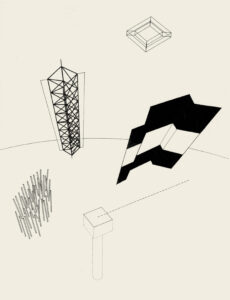
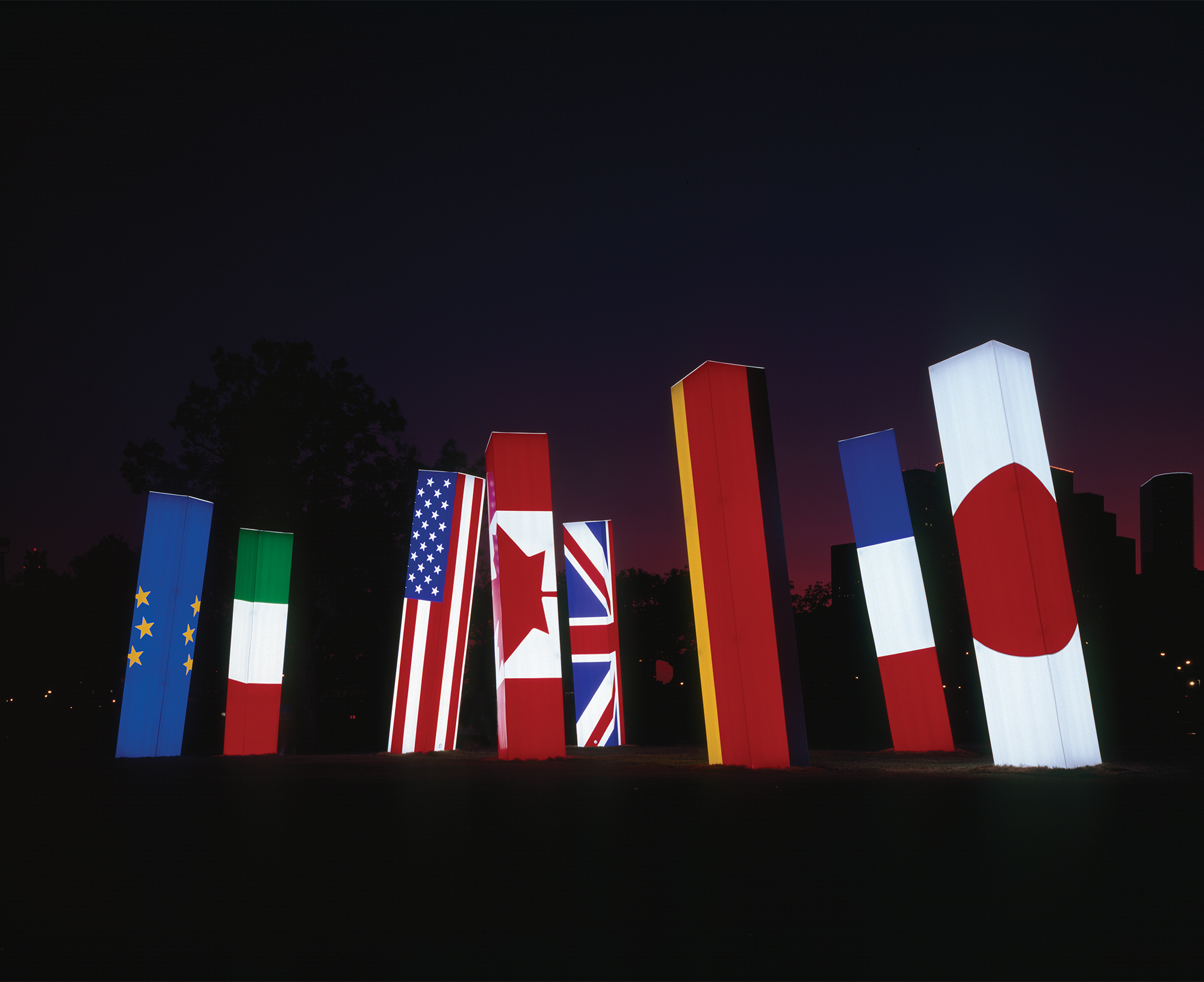
The Light Spikes were created for the G7 Summit held in Houston during the summer of 1990. Although some people believe that they were commissioned for the Summit, the truth is that they were volunteered for the event. Initially, I envisioned illuminated flag columns placed all over Houston: in esplanades, on buildings, at the Mecom Fountain, at the Water Wall adjacent to Transco Tower, and at Rice University. The idea owed a lot to Christo. I created colored paper collages on black-and-white photographs to describe the idea to anyone who would listen.Through the invitation of colleagues, I attended regular meetings of the Host Committee. It was co-chaired by Ken Lay and George Strake, Jr. Committee meetings took place at Transco around a table seating some 100 people. After weeks of presenting the idea, I was summoned to a small meeting of the Host Committee. Ken Lay asked me to explain what these “Light Spikes” were. I don’t remember precisely what I told the Host Committee, but my basic message was that the Light Spikes were intended as a sculptural welcome. He said that the location would be the lawn in front of the George R. Brown Convention Center, that he would allocate $40,000, and that I would be on my own for the rest.
Suddenly, I got a call from the Protocol Committee. They informed me that there was an international agreement for the display of flags at the Summit. In Houston’s case, the American flag would be first. To its right, the flags of each country would be arranged in alphabetical order, ending with the flag of the European Union. I replied, “But these are going to be seen in 360 degrees. There will be no way to guarantee alignment.” I was told, “Well, you’d better figure something out. It’s not going to be our problem.”
What to do? I had always imagined these things leaning rather than sitting vertically, and I thought maybe they could lean together somehow. Then I came up with an arcane idea. What if all the Light Spikes leaned toward a common center point? What if that center point represented Houston? What if the distance from that center point to any given Light Spike were proportional to the distance between Houston and the capital of each symbolized country?
The next step was to determine the proportional distances, which proved to be a challenge. In 1990 the Internet did not yet exist, and I didn’t have a set of encyclopedias in my office. So I did what any self-respecting arcane idea guy would do: I called Continental Airlines. With a very helpful young woman from Continental on the phone, I asked her if she could assist me. “I’ll try,” she said. “Okay, thanks. As the crow flies, how far is it from Houston to Berlin? Great. How about from Houston to Tokyo?” You get the idea. After several minutes, I had the distances from Houston to all eight destinations. After that, it was a matter of assigning a unit of measure and composing the eight Light Spikes in a configuration that would be both pleasing and appropriate.
Central to the idea of the Light Spikes was that they be fully and evenly illuminated. Furthermore, they had to alight on the ground without any obvious means of support. To achieve the desired results, I needed to coordinate with multiple subcontractors. Host Committee funds were allocated to the fabricators of frame structures with an attached fluorescent light source. Their work began several months before the Summit. Assembly of the vinyl flag skins also began well in advance. However, the remainder of the work began five days before the event. Volunteer companies provided excavation, rebar placement, concrete pours, and underground electrical service. Once the bases were ready, the frames were lifted into place by a crane and secured. Then each vinyl skin was gently draped over the corresponding structure and made taut by use of the diagonal corner fins. In Houston in July, the sun doesn’t set until about 8:30 pm. The long summer days proved to be fortunate for us, because we needed all the time we could get. When the construction teams began to clear, passersby and notified friends began to arrive. As darkness approached, I decided to illuminate the Light Spikes by following protocol. A man on the frame fabricator’s team had served in Vietnam, so he flipped the American switch.
It worked. So did the following seven. Applause and the popping of champagne corks ensued. The success of this project was rather amazing, since we hadn’t had time for a test run.
More


Jay Baker Architects
Jay Baker
Contractor
Hendee Enterprises
3M
Enduro Awnings
Manhattan Construction
Engineers
CBM Engineers Inc.
Day Brown Rice